
A probability, its evidence, and where in the frame
Each image, video or audio item that is examined gets a verdict record. It says what was found, how certain that is, on what evidence, where in the item, and where the item first appeared.

01
The verdict
One of five words, below. None of them says that an item is genuine.
02
The certainty
High, likely or none. It is shown with the probability only when it carries information; an inconclusive verdict shows the reason instead.
03
The probability
Calibrated on Indian data for that kind of media, or labelled uncalibrated, in which case a score is shown and no probability.
04
Where
The regions in the frame and the stretches of time that the finding rests on, each with its own certainty.
05
The kinds of evidence
Image detail, frame continuity, the audio, lips against speech, content credentials and earlier copies. Which kinds agreed decides how certain the verdict can be.
06
First seen
The earliest copy found, its platform and time, from all the copies of the same item.
The five verdict words
AI-generated
On Home: AI-generated, or Probably AI-generated when the certainty is likely
Partially manipulated
On Home: Partly edited or doctored, or Probably partly edited when likely
Manipulated
On Home: Edited or doctored, or Probably edited when likely
No evidence found
On Home: No sign of faking
Inconclusive
On Home: Could not tell
Real is not a verdict.
There is no sixth word. “No evidence found” means that checks validated for that kind of media looked and found nothing. When no validated check could look, the verdict is inconclusive.
What is checked
Under every verdict, the Media screen lists what was checked: six rows, always present, each with its outcome: found, not found, inconclusive, not applicable or still checking. A row that was not decided shows the reason.
Before anything is scored, gates decide what applies; a gate never scores. With no face in the frame, the face and lip-sync checks do not apply. With under three seconds of speech, the voice, speaker and lip-sync checks do not apply; music over the speech turns off the voice check only. A dubbed track turns the lip-sync check off, because dubbing is legitimate and common in India.
Quality is graded low, medium or high from the platform’s own copy, and a low-quality item needs one more independent kind of evidence for any finding. Edits that add to the media or trim it without changing what it shows, such as a logo, a ticker, a caption, a split screen or a crop, are found and set apart. A ticker whose words differ from the earliest copy’s is a finding of alteration.

01
Fully AI-generated
The whole image or video made by a generator. Found only when the verdict is AI-generated.
02
Part manufactured or AI-altered
Part of the item made or changed: a region, spliced or generated frames. A plain crop is an edit and never counts here.
03
Face manipulated
A face swapped or altered, read from the faces found in the frame. The row says how many faces carry it, for example 2 of 3.
04
Voice AI-generated
A synthetic or cloned voice in all or part of the track.
05
Lip-sync mismatch
Lips that do not move with the speech.
06
Deepfake
The face and lip-sync rows read together.
Where in the frame
A finding names where it is: regions marked on the item’s key frames, and stretches of time, such as 0:12 to 0:41 of the audio track.
Each region and stretch carries its own certainty, under the same rules as the whole item. One whose checks are not validated, or disagree, is inconclusive and cannot raise the verdict.
A region that lies at least half on a logo, a caption, a ticker, a split screen or the frame’s border is marked as overlapping an edit and left out of the verdict. It stays visible to the analyst.

Where it first appeared
Every copy of the same media is gathered into one item, on whatever platform it was posted, so the verdict is made once and the spread is seen whole.
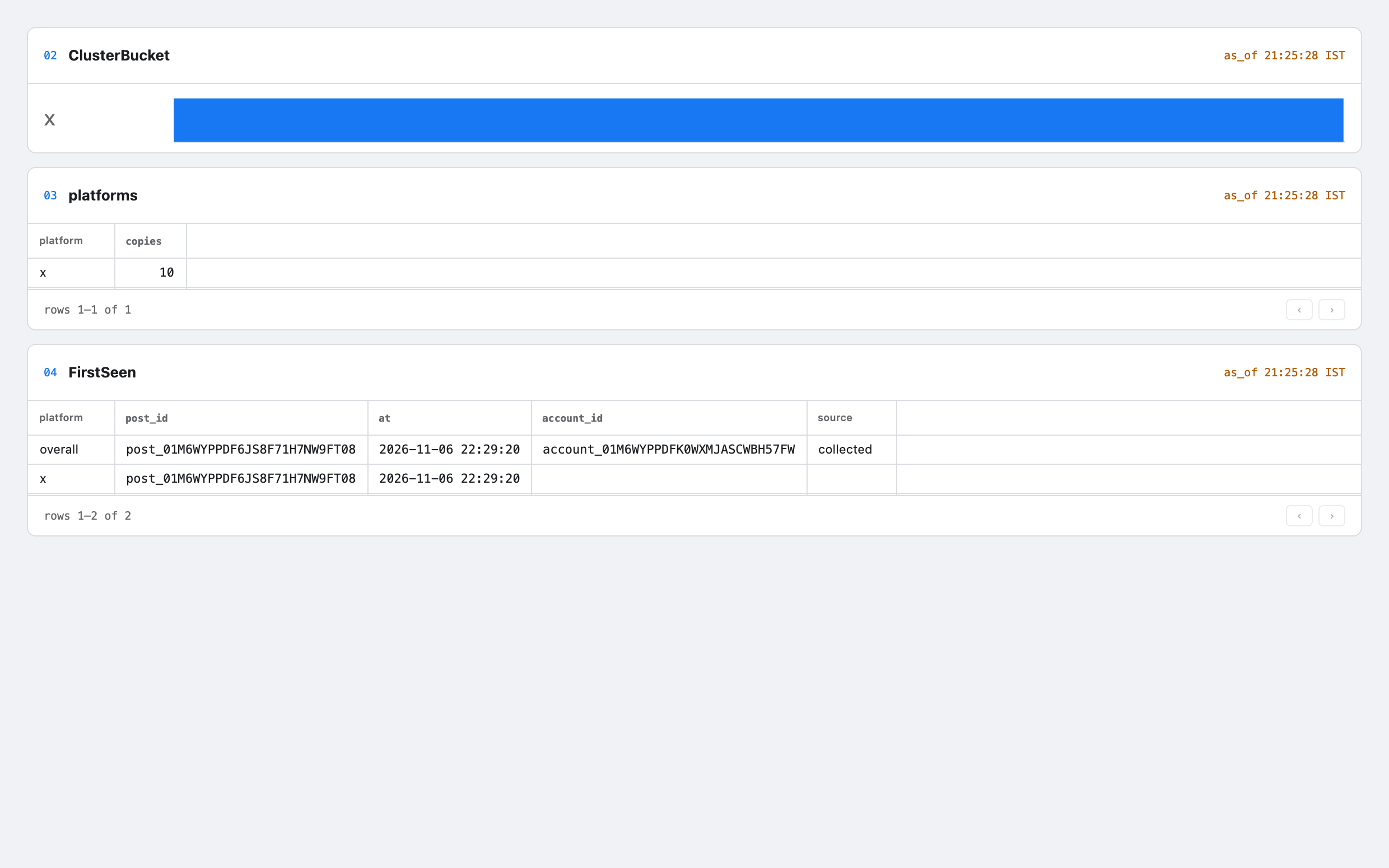
Images and video are matched by their visual fingerprint, video frame by frame, and audio is matched on its own. The item shows the copies on each platform, how it spread in five-minute steps over 48 hours, and the first copy seen, overall and on each platform.
How sure the first sighting is reads high, medium or low, with a note when watching began late or a reverse image search found an earlier copy on the web. An earlier identical copy that the product holds itself, the same frames and the same sound, shows the item unchanged since that copy; a copy found only on the web is never used that way.

Two kinds of evidence must agree
High certainty needs two validated checks of different kinds of evidence to agree, and a combined score high enough. One validated check agreeing can reach likely at most.
Likely itself needs a combined score high enough, at least one validated check agreeing, and no validated check scoring below the inconclusive line. Two checks of the same kind, whoever makes them, count as one kind of evidence. A check that has not been validated for the kind of media in front of it is shown as evidence and never counts toward high, and no finding is ever built on unvalidated checks alone.
For a voice, two audio models are one kind of evidence, so a synthetic voice can reach high only when a validated lip-sync check agrees as well.
The one exception is trusted provenance: a valid content credential from a trusted signer, or a hit from a trusted watermark detector, decides on its own. It is described under Content credentials, below.

Content credentials
Some cameras, editing tools and generators sign a content credential into the file, in the C2PA format, saying how it was made. Each examined file’s credential is read, with three main outcomes.
Trusted signers come only from the published C2PA trust list, recorded with its source and date. A trusted credential that records AI actions is one of the two cases in which certainty is high without two kinds of evidence; the other is a trusted watermark, below.
A platform’s own AI label, or a valid credential from a signer that is not trusted saying the item was generated, is marked as declared by the uploader: it can nudge the confidence once, and never moves the certainty or decides the verdict. An edit recorded in a credential, such as a retouch, is evidence only.
Watermarks follow the same rule. A hit from a watermark detector on the trusted list decides as a trusted credential does; a watermark of a kind that can be forged is evidence only.
Trusted, with AI actions
Decides the verdict: AI-generated when it covers the whole item, partially manipulated, with one region or stretch per action, when it does not.
Trusted, from a camera, no AI actions
Changes no verdict and is listed as evidence.
Invalid or unreadable
Evidence only, and moves nothing. It happens when a messaging app re-encodes a phone video.
The written explanation
Each flagged verdict gets a short written explanation for a reader who is not an analyst, added once the fuller examination has run. A language model writes it from the verdict’s own records; the post’s words and any words on screen are treated as material to describe, never as instructions.

01
One sentence first
Whether the item is manipulated and how sure that is, in at most 30 words.
02
What was checked
The post, the media, and which checks ran and which are validated, in plain words.
03
What was found
Naming what can be seen in the item, not scores.
04
Why to be careful
For example: one validated check only, checks that disagree, or watching that began late.
05
What to do
Monitor or escalate, in words.
Limits
Before an installation’s baseline weeks are complete, no detector has passed validation on Indian media. Validation is done in each installation during those weeks, on a reference set of Indian media that your analysts label: news clips with logos, tickers and split screens, phone videos, memes with text, music, silence, and re-encoded copies of the same items.
A detector counts for a kind of media only after it has passed a test on at least 200 items of that kind from the reference set, with every declared kind of footage represented by at least 20, and an approver has signed the result off. Until then its results are shown as evidence. While no detector has passed for a kind of media, verdicts on it are inconclusive, unless a trusted content credential or watermark decides. That is the intended behaviour.
The first kinds of media aimed at are images and video of medium and high quality, Hindi audio of medium quality, and video checked for lips against speech at medium quality. Low-quality images and video, low-quality Hindi audio and a regional language follow as the labelled set grows.
Each validated detector is tested again every month and whenever its model changes. One that starts to flag too many items from the reference set stops counting until it passes again.
The written explanation never changes a verdict. When it disagrees with the checks it says so, and the item goes to the top of the review queue. Its wording is checked in English, Hindi and Hinglish: a negative reads “no evidence of manipulation found”, and words such as fake or synthetic are refused unless the verdict found something.
A verdict is released for use outside your team only after an analyst has confirmed it.
Questions
Will it tell us an item is genuine?
No. The strongest negative is “no evidence found”: checks validated for that kind of media looked and found nothing. It is never a statement that the item is genuine.
Which media is examined?
By default: an item seen by at least 10,000 people (50,000 on YouTube), one in a trending topic seen by at least 1,000, one sent by a rule, one with AI actions in its credential, and any single link or file you submit, which is asked all six questions.
Can our staff send in a clip they were forwarded?
Yes. A video or screenshot forwarded from WhatsApp is submitted as a single file and examined like any other item.
What happens if a verdict is later overturned?
A correction is issued. A report that carried it gets an addendum sent to every original recipient, and the verdict’s screen shows the correction. Nothing is edited silently.
Bring a clip your team has had to answer for, and see the record it would get and what that record would say.
Request a demo/platform/media-forensics · Media forensics