
A spike is not a build
A topic can trend in two ways: a burst that lives about an hour, or a rise that holds for a day or longer without a sharp peak. Each is tested on its own.

01
The spike
The last 15 minutes are compared with the topic’s usual level at the same time of day over the previous seven days. It counts only when it is well above that level, passes a test of how unusual it is for this topic, and comes from at least 20 different accounts.
02
The build
The last 24 hours are compared with the topic’s usual day over the previous 14 days, leaving out the current day. It counts when it is at least three times the usual day, has at least 500 posts, and the rise is spread across the day. A one-hour spike in an ordinary day is a burst, not a build.
03
Why both are needed
After a day, a slow rise becomes part of the topic’s own usual level, and a burst test alone would stop seeing it. A topic can be both at once; on screen a build reads as "Busy all day".
04
Usual for this hour
Mornings are compared with mornings. With four weeks of history, Monday mornings are compared with Monday mornings. A topic with less than a day of history is compared with ordinary topics on the same platform and in the same language; in its first week its usual level is not allowed to fall below theirs.
The life of a topic
While a topic is active it is in one phase at a time, and a phase holds for a set time before it can change, so one noisy reading does not move it. A topic that comes back after fading starts again from the first phase.
01
Just started
Activity has doubled and is climbing, or is accelerating sharply before that.
02
Picking up
Trending and still climbing.
03
At its peak
Level for ten minutes. The time of the peak is recorded.
04
Calming down
Falling for ten minutes, or below six tenths of its peak.
05
Faded
Below one and a half times usual for 30 minutes.
06
Returned
Not a phase of its own: a topic that comes back starts again, keeping its record and history. Each return is a new episode with its own start time and length.
The ranked list
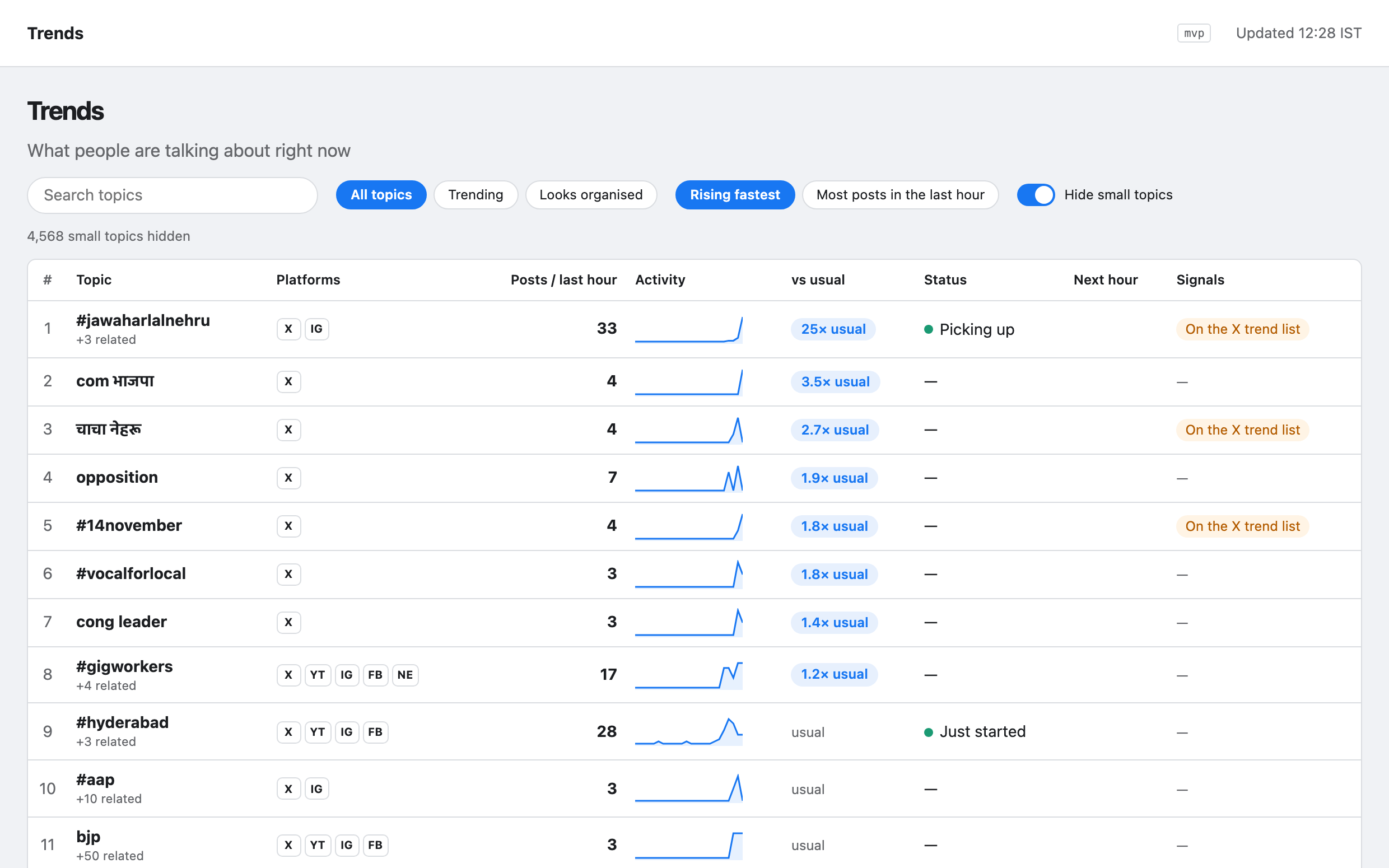
Trends lists every topic, hottest first: posts in the last hour, how far above usual, which way it is moving, and whether anything about it looks off.

01
Hottest first
Ordered by posts in the last hour, then by how far above usual.
02
Times usual, only while current
Shown as "6.2× usual" when the topic’s last check is at most 90 minutes old. Older readings are left blank rather than shown as now.
03
Status and the next hour
The phase in words, such as "Picking up", and the next-hour direction, marked "not yet checked".
04
What looks off
"Looks organised" when coordinated activity has been found, and "One source" when one account is doing most of the posting.
Why it moved
Timeline gives each topic a lane on one time axis, with a plain sentence on what is happening, such as "About 3.9× its usual activity. Picking up since 15:10."

The Timeline for 12 Nov is dragged back in time: the six-hour window ending 19:55 IST moves back to the one ending 15:35 IST, and the chart of all topics and each topic’s lane redraw for the new window.
01
Activity against usual
The activity line with the trending level marked, and the next hour drawn after the now line.
02
Phase, organisation and opinion
A phase strip, a band for organised activity and a strip for for, against and neutral, read on the same axis.
03
What happened when
A square where an alert rule fired and a circle where media received a verdict, at the time each happened.
By state
Each topic shows its three leading states with their share of posts, and the share that could not be placed.
A post is placed by the region it was collected under, or else by the location its author gives, read against a gazetteer of places. Below the state, an author’s location resolves to a district where the gazetteer allows; a watch list set to a parliamentary or assembly constituency, from the Election Commission lists, places its posts there.
Posts with no usable location are counted as unassigned. That share is shown, not spread across states.

One account is doing most of the posting.
The console’s warning, in full: "One account is doing most of the posting, so this may be pushed rather than real interest."
It appears when a topic would otherwise count as trending, but fewer than 20 different accounts are posting, or one account has more than half of the posts. Reposts count toward the account that reposts.
Such a topic is not counted as a trend. It stays on the list with its activity and the account behind it, because one very loud account is itself worth seeing.
Limits
Some platforms cannot be asked only for posts newer than the last check. Then activity is counted from new posts in each check, up to a cap, and the trend is marked as sampled.
When the first posts of a subject cannot be reached by looking back, its start time is marked low confidence.
A subject is seen only through what is collected. A topic that never uses a watched word is missed, unless it reaches the X trend list for India and is suggested.
How sensitive detection is comes from one of three settings, fewer, balanced or more, and the policy owner changes it. A preview replays the last seven days of history under each setting, so the choice can be made on evidence.
Questions
How quickly is a trend seen?
Trends are rechecked every minute for topics marked hot and every five minutes for the rest.
What does "usual" mean for a new topic?
For its first day it is compared with ordinary topics on the same platform and in the same language; then with its own history, and by time of day from its third day. Each trend reading says which usual level it was measured against.
Can one account make a topic trend?
Not by posting volume alone. A rise counts as a trend only with at least 20 different accounts and no account holding more than half of the posts; otherwise it is listed with the "One source" warning. A topic on a platform’s own trend list is still marked as trending.
Can we change how sensitive it is?
Yes, between three settings, changed by the policy owner. A preview can replay the last seven days under each setting to show how many trends each would have flagged.
Bring a topic your team followed closely, and see how its rise and fall would be read.
Request a demo/platform/trends · Trend detection