
Three risks to a large company
Media Verdict was specified for watching political conversation in India. Three of the things it watches for can also reach a large company.
A manufactured outcry
Accounts acting together within seconds of each other can make a complaint look like a groundswell. The product shows whether a push is ordinary interest or coordinated, with the accounts and the evidence.
Altered media of an executive
A clip in which an executive appears to say or do something. The product examines the media itself: what was found, how certain, where in it, and where it first appeared.
What AI assistants tell people about you
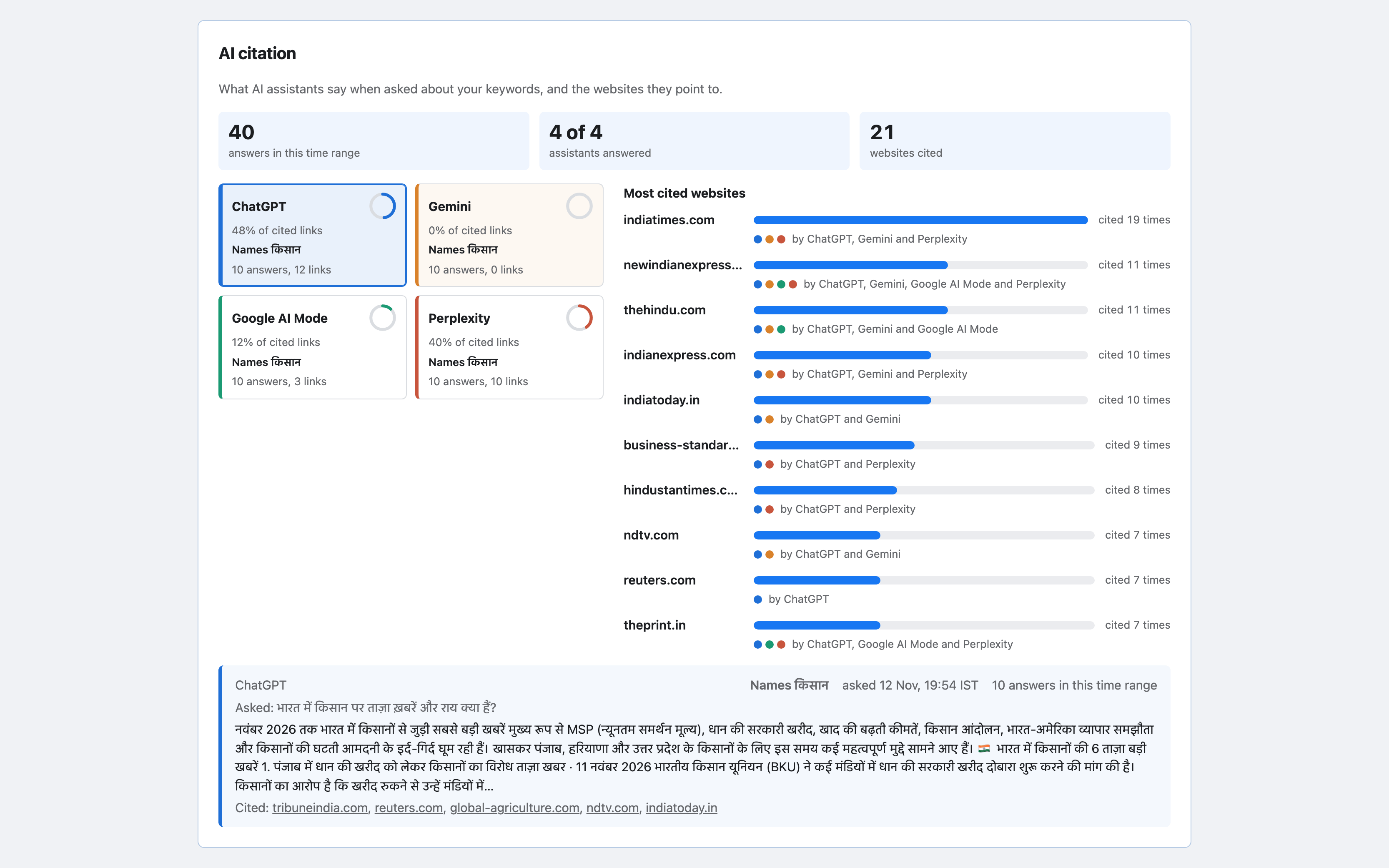
What ChatGPT, Gemini, Google AI Mode and Perplexity answer about your keywords, and which websites they cite.
A corporate communications team’s day
One day, from the morning briefing to the evening report.

Offered, and not offered
Five capabilities a company can use, and three things the product does not do.
| Capability | Offered | What that means for a company |
|---|---|---|
| Social listening | Offered | The company’s names, products, executives and campaigns watched as keywords and accounts, across platforms and twelve Indian languages. |
| Forecasts | Offered | Whether a watched keyword, such as the company’s name, is likely to rise, stay about the same or fall in the next hour, and why. |
| Coordinated-push detection | Offered | When complaints about the company surge, whether that is ordinary interest or accounts acting together, shown with the accounts and the evidence. |
| Media forensics | Offered | A verdict on an image, video or audio clip: what was found, how certain, where in it, and where it first appeared. |
| AI answers | Offered | What AI assistants tell people who ask about the company’s keywords, and which websites those answers cite. |
| Brand sentiment scoring | Not offered | The product’s stance measure reads whether posts are for, against or neutral toward the government and the other bodies an installation names. It does not measure how people feel about a brand or a product, and is not offered as one. |
| Customer care | Not offered | It is not a tool for answering customers’ questions or complaints. |
| A publishing calendar | Not offered | Nothing is scheduled to be sent later, and there is no content calendar. |
Altered media of a named person
The product examines the media, not the person. It does not recognise who appears in a clip: your team knows who the executive is, and the product shows what was done to the media.
Faces are located in the frame so they can be checked for manipulation, and are never matched to a person. Recognising private individuals is one of the product’s stated non-goals, and faces are pixelated in external reports.
To find such a clip, the executive’s name is watched as a keyword, in each language and spelling your team gives. Media is examined when it reaches enough people, by default 10,000 (50,000 on YouTube), when a rule sends it, or when your team submits the link or the file.
A finding says what was found and where: a face swapped or altered, a synthetic or cloned voice, or lips that do not move with the speech, with the stretch of time it covers, such as 0:12 to 0:41 of the audio track, and the earliest copy found.
Saying in public that a clip is altered waits for an analyst to confirm the verdict.

What assistants cite about you
Each keyword listed for AI answers is put as a plain question to ChatGPT, Gemini, Google AI Mode and Perplexity. What each answered, and which websites it cited, is kept.
The questions are neutral and open: what is being said about the keyword in India right now, the latest news and opinions about it, and which people and groups in India are talking about it. By default each question is put to each assistant once a day.
On Home, the AI citation card ranks the websites cited across the four assistants and shows whether each one’s latest answer names the keyword. The keyword report marks the cited websites that also appear in the news.
Answers differ between runs. What is kept is a sample of the same fixed questions, not every answer an assistant could give.

Fit for a large organisation
Single sign-on
Users sign in through your identity provider, roles come from its groups, and approvers and admins use two factors. The product stores no passwords.
Audit trail
Every change, approval, verdict, flag and action is kept in an append-only audit log, and each user has an audit trail of their own.
Your own installation
The same build on your own servers in India, with a database no other client uses, or as one client of the shared system.
Questions
Does it measure sentiment about our brand?
No. Its stance measure reads posts as for, against or neutral toward the government and the other bodies an installation names. It is not a brand sentiment score.
Can it tell us who made an altered video?
No. It says what was done to the media, where, how certain that is, and the earliest copy found. It does not identify the people in it or behind it.
Can it answer customers or schedule our posts?
No. It is not a customer care tool, and it has no publishing calendar.
In which languages?
Posts are read in twelve Indian languages, Hindi, English and Hinglish among them. The console itself is in English.
Name the keywords your team would watch, and see how a manufactured push and an altered clip would appear.
Request a demo/solutions/brands · Brands and corporate communications