
Paste a link, get the evidence
Submit the link of a post, video or image, or upload the file itself, and the item is examined. A video forwarded on WhatsApp is submitted the same way, as a file.
A submitted item is checked on all six rows: fully AI-generated, part manufactured or AI-altered, face manipulated, voice AI-generated, lip-sync mismatch, and deepfake. The verdict comes with its certainty and its probability; with a score and no probability where it is uncalibrated; or with the reason it is inconclusive. It also says where in the item the finding rests, and gives the earliest copy found.
The result can be attached to a case, so the desk’s work on one story stays in one place.

A verification desk’s day
The checking work of one day, in order, from the morning briefing to the evening report.

What you can say, and what you cannot
Six rules for what a desk can say in public on the strength of a verdict. Each follows from what the product itself will and will not state.
You can say an item is AI-generated, partially manipulated or manipulated once an analyst has confirmed the verdict. Until then it is not released for use outside your team, and the product makes no public claim that anything is fake without that confirmation.
You cannot say the product found an item genuine: it has no such verdict. The strongest negative is “no evidence found”, meaning checks validated for that kind of media looked and found nothing. Releasing a negative outside your team needs its own decision and uses fixed wording: “no evidence of manipulation found”.
Say how sure, in the record’s words. High certainty needs two validated checks of different kinds of evidence to agree and a combined score high enough, unless a trusted content credential or watermark decides; one validated check agreeing can reach likely at most. A probability is calibrated on Indian data, or labelled uncalibrated, in which case a score is shown and no probability.
Inconclusive is an answer, and it carries its reason: no validated check could look, no check ran, or the validated checks disagreed. Say that it could not be decided, not that the item is clean.
Say where, and where it was first seen: the region of the frame or the stretch of the track the finding rests on, and the earliest copy found, with how sure that first sighting is.
Do not say who made it. A face is located in the frame to check it for manipulation and never matched to a person, and faces are pixelated in external reports. A coordination finding shows which accounts acted together, not who is behind them.
Where it first appeared
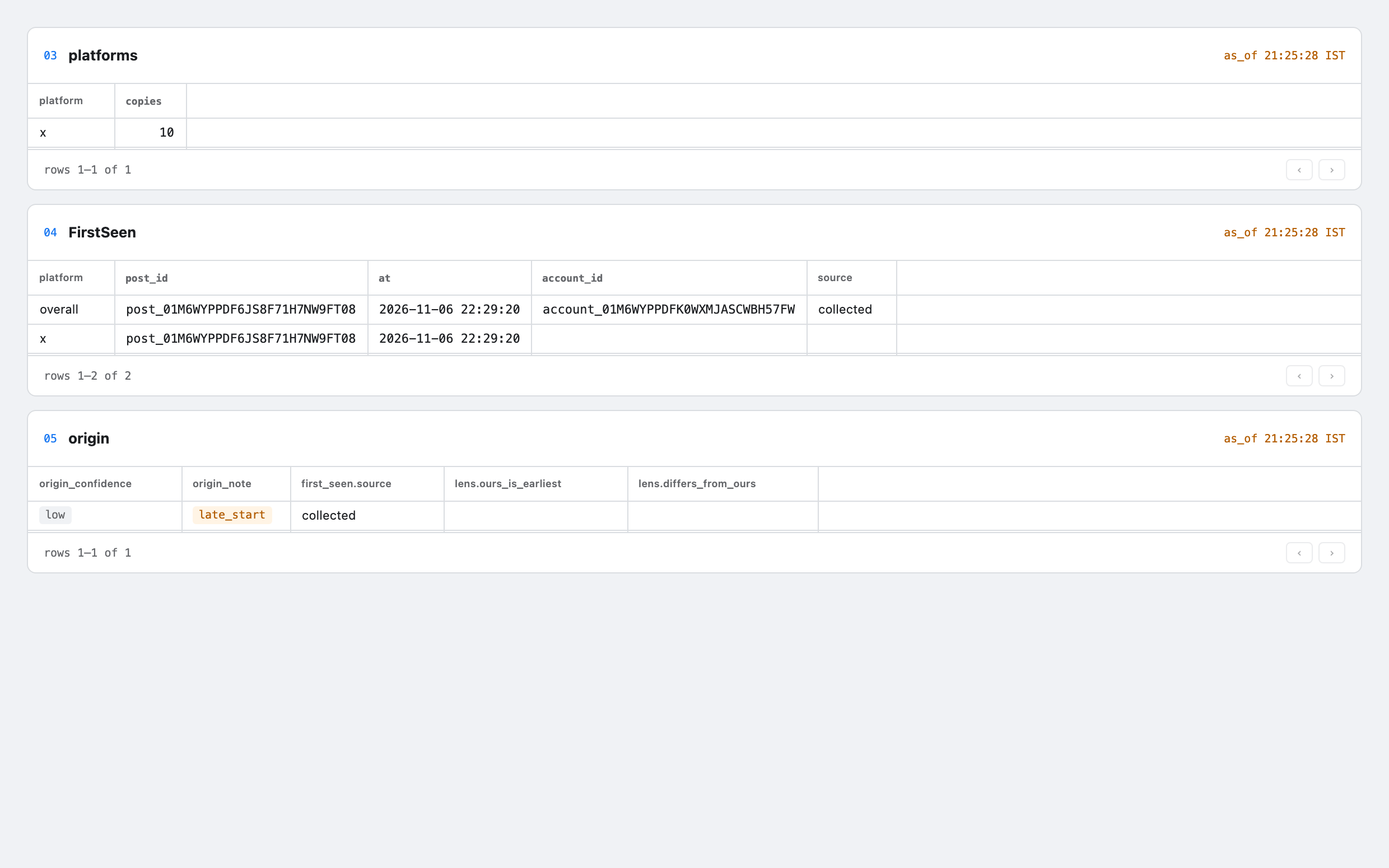
Every copy of the same media, on whatever platform it was posted, is gathered into one item, so the spread is seen whole and the first copy can be found.

01
First seen
The platform, account and time of the earliest copy, overall and on each platform.
02
How sure
High, medium or low, with a note when watching began late or a reverse image search found an earlier copy on the web.
03
Copies
How many on each platform, and how the item spread in five-minute steps over 48 hours.
04
Matched by what it is
Images and video by their visual fingerprint, video frame by frame. Audio is matched on its own, so the same soundtrack is found under different pictures.
Evidence for the desk
The verdict’s written explanation and the report that carries it, as the desk reads them.

01
One sentence first
Whether the item is manipulated and how sure that is, in at most 30 words.
02
What was checked, and what was found
Which checks ran and which are validated, and what can be seen in the item, in plain words rather than scores.
03
Why to be careful
For example: one validated check only, checks that disagree, or watching that began late.
04
In the daily report
Verdicts of likely or high certainty with where they rest, their origin and review status; inconclusive ones listed separately. The external version carries confirmed verdicts only.
When a verdict changes
01
An analyst overturns it
A released verdict that an analyst later overturns, or that is disputed, creates a correction.
02
Every recipient is told
A report that carried it gets an addendum, delivered to every original recipient.
03
Nothing is edited silently
The verdict’s screen shows the correction, and the decisions made on it stay visible.
04
The fuller examination arrives
When a fuller examination follows a first, quicker verdict, it produces a new verdict that supersedes the first, and the screen moves to it. Until it arrives, the questions not yet decided read as still checking.
05
A check stops counting
Each validated detector is tested again every month and whenever its model changes. One that starts to flag too many items stops counting until it passes again.
Questions
Can we publish “no evidence found” as a finding?
Only as what it is: checks validated for that kind of media looked and found nothing. Releasing a negative outside your team needs its own decision and uses the fixed wording “no evidence of manipulation found”.
Can it tell us whether a clip is being pushed?
It shows whether accounts acted together, the same action within seconds far more often than chance, with the accounts and the evidence. It does not say who is behind them.
Can we search what was said in a video?
Yes. One search covers the words of a post, the text read from its images and the words spoken in its video or audio, in twelve Indian languages.
Does it read WhatsApp?
No. A clip forwarded on WhatsApp can be submitted as a file, and a campaign organised there is seen only when it reaches public platforms.
Bring a clip your desk has had to check, and see the record it would get and what you could say about it.
Request a demo/solutions/newsrooms · Newsrooms and fact-checkers